That unforgettable restaurant meal? Let’s make it at home.
The pasta you had in Italy. The extraordinary dessert from your anniversary dinner. The restaurant dish you’ve ordered three times because you can’t stop thinking about it.
Meet Morsel, your personal AI culinary companion.
Bring a menu, a photograph, or whatever you remember about a dish. Morsel helps you investigate the ingredients, uncover the cooking techniques, and develop a recipe inspired by the meal you loved.
For curious home cooks who believe the best meals deserve a second helping.

You’ve been thinking about that meal ever since.
You know the one.
The little restaurant you found by accident. The dish you ordered because someone at the next table was having it. The first bite that made everyone stop talking for a moment.
Naturally, you decided you could probably make it at home.
You found a recipe online. Bought the ingredients. Followed the instructions.
It was lovely.
It tasted absolutely nothing like the original.
Perhaps the sauce was missing something. Perhaps the texture was wrong. Perhaps the restaurant had performed some small act of culinary witchcraft involving butter.
The trouble is, a recipe rarely tells you everything that made a dish memorable.
The balance of acidity and richness.
The way an ingredient was prepared.
The order in which things were cooked.
The finishing touch that made the whole thing sing.
Those are the details Morsel helps you investigate.
Meet your personal culinary companion.
Morsel is an interactive AI guide inside ChatGPT, created to help you explore, reconstruct, and refine the dishes you want to make again.
You might begin with
A restaurant menu.
A photograph from your holiday.
A handwritten recipe with half the instructions missing.
Or a memory of something delicious that you haven’t been able to find since.
Morsel asks questions about the flavors, textures, ingredients, and techniques you remember.
Then it helps you develop a recipe based on what you’ve described, including suggested ingredients, preparation methods, timing, and possible substitutions.
You can ask why a particular technique matters, explore different approaches, and refine the recipe after cooking it.
And when another wonderful meal comes along, you can begin a completely new conversation.
What would you love to make again?
That restaurant dish you still talk about
The mushroom risotto in Florence. The extraordinary roast chicken at a little French bistro. The pasta you ordered twice during a three-day holiday.
Bring the menu description, photograph, or details you remember.
Morsel helps you investigate the likely ingredients and techniques, then develop a version to try in your own kitchen.
The family recipe nobody wrote down
Your grandmother’s Sunday lunch. The cake your aunt always brought to birthdays. The dish everyone remembers, although nobody can agree on exactly how it was made.
Start with what you know.
The ingredients someone remembers. The texture. The smell from the kitchen. The way it looked when it arrived at the table.
Morsel helps you turn those fragments into a recipe you can test, adjust, and preserve.
The meal you discovered on holiday
Perhaps it was a smoky soup in a tiny restaurant overseas. Or a dessert with a flavor combination you’ve never encountered before.
Explore the cuisine, ingredients, preparation techniques, and possible ways to recreate something inspired by the original.
A lovely way to bring a little of the holiday home.
The recipe you’d like to make your own
Found a dish you love but want to adjust the ingredients?
Morsel can help you explore substitutions, preparation methods, and ways to adapt a recipe to your preferences.
You can return to the conversation after cooking and refine the next version based on what actually happened in your kitchen.
The case of the Mississippi mud cake that ruined all other chocolate cakes.
It was the last day of a dream girls’ trip to New Orleans.
There had been cocktails. Extraordinary food. Long conversations. The kind of laughter that makes your stomach hurt and causes strangers at nearby tables to reconsider their seating arrangements.
And now, one final meal before heading home.
Someone ordered dessert.
A Mississippi mud cake arrived at the table, dark and gloriously chocolatey, with a warm, molten sauce hiding beneath the sponge.
One spoonful in, and the conversation stopped.
You know a dessert is exceptional when it silences a table of women who have spent the better part of a week talking.
Naturally, everyone wanted a taste.
And eight years later, you still think about that cake.
You’ve tried finding a recipe. There are hundreds. Some have marshmallows. Others have pecans. Some are dense chocolate cakes covered in frosting.
None looks quite like the warm, self-saucing masterpiece you remember.
Which is where Morsel comes in.
Look More Closely
Every unforgettable meal is built from details worth noticing. Morsel helps you recreate restaurant recipes by uncovering the flavors, textures, techniques, and memories that transform a favorite dish into an experience you can enjoy again.
Understand Deeply
Thoughtful questions reveal the hidden elements behind memorable cooking, from flavor profiles and preparation techniques to the small decisions that shape every bite. Whether you're working from a menu, a photograph, or a cherished memory, every conversation builds a more complete recipe.
Make It Personal
With a deeper understanding of what made a meal unforgettable, you can confidently recreate restaurant meals, rebuild treasured family recipes, and develop personalized recipes that bring meaningful food memories back to your own table.
You bring the memory. Morsel starts investigating.
You explain:
“On the last day of a girls’ trip to New Orleans, we had the most incredible Mississippi mud cake. It was warm, intensely chocolatey, and had this gorgeous sauce underneath. I’ve been trying to find something like it ever since.”
Morsel has questions.
- —Was the top soft and cakey, or did it have a delicate crust?
- —Was the sauce thick and fudgy, or dark and glossy enough to run across the plate?
- —Did the chocolate taste rich and bittersweet, or sweet and almost caramel-like?
- —Was there a hint of coffee? A little salt? Something that made the chocolate taste even more chocolatey?
- —And how was it served? Straight from the baking dish? With vanilla ice cream? A generous spoonful of whipped cream?
You start remembering things.
The sauce was definitely warm.
The cake had a proper sponge on top, but underneath was this extraordinary pool of chocolate.
And there may have been ice cream involved. Although, frankly, there were cocktails involved too, so some details are open to interpretation.
Now we’re getting somewhere.
Morsel helps you investigate the kind of dessert you’re remembering.
You’ll explore the difference between a traditional Mississippi mud cake and a self-saucing chocolate pudding, and how to combine the characteristics that made your particular dessert so wonderful.
Perhaps the secret lies in the cocoa-to-sugar ratio.
Perhaps it’s the way hot liquid is added before baking, allowing a chocolate sauce to form beneath the sponge.
Or perhaps the chocolate needs a little coffee and salt to develop that deep, almost outrageous richness.
Morsel helps you develop a recipe with ingredients, quantities, baking instructions, and techniques to try.
A working recipe inspired by the dessert you remember.

And then comes the taste test.
The kitchen smells like a chocolate shop.
You pull the cake from the oven, let it settle, and slide a spoon through the top.
There it is.
Warm chocolate sauce, gathering beneath a soft, dark sponge.
You take a bite.
Oh, that’s good.
The sauce could be a little thicker. The chocolate perhaps a touch darker. And next time, you’re absolutely adding vanilla ice cream.
So you tell Morsel.
Together, you explore what to adjust for the next attempt. A little less liquid? A different cocoa? A shorter baking time?
The recipe evolves as you cook, taste, and refine it.
And eventually, you invite the girls over.
You put the cake on the table, hand everyone a spoon, and watch the first bites disappear.
Someone remembers the restaurant.
Someone brings up a story from the trip that really shouldn’t be repeated.
And suddenly, New Orleans doesn’t feel quite so far away.
Imagine what else you could bring back to the table.
The dessert from your anniversary dinner. Your grandmother’s famous cake. The extraordinary dish you ordered on holiday and have been talking about ever since.
Bring the menu, the photograph, or whatever you remember.
Morsel will help you investigate the ingredients, understand the techniques, and develop a recipe you can make your own.
Because a great recipe is about more than the ingredients.
Morsel helps you develop three practical skills you can bring to future cooking projects.
Understand what creates flavor.
Explore how ingredients, seasoning, acidity, fat, texture, and preparation methods contribute to the finished dish.
Learn why techniques matter.
Ask questions about cooking methods, ingredient preparation, timing, and the small decisions that can change the result.
Refine recipes through experience.
Use what you notice while cooking to adjust the next version, experiment with substitutions, and develop recipes that suit your tastes.
You can use Morsel for a special dinner, a family favorite, a holiday memory, or a dish you simply feel like mastering.
One culinary companion. As many conversations as you have dishes you’d love to explore.
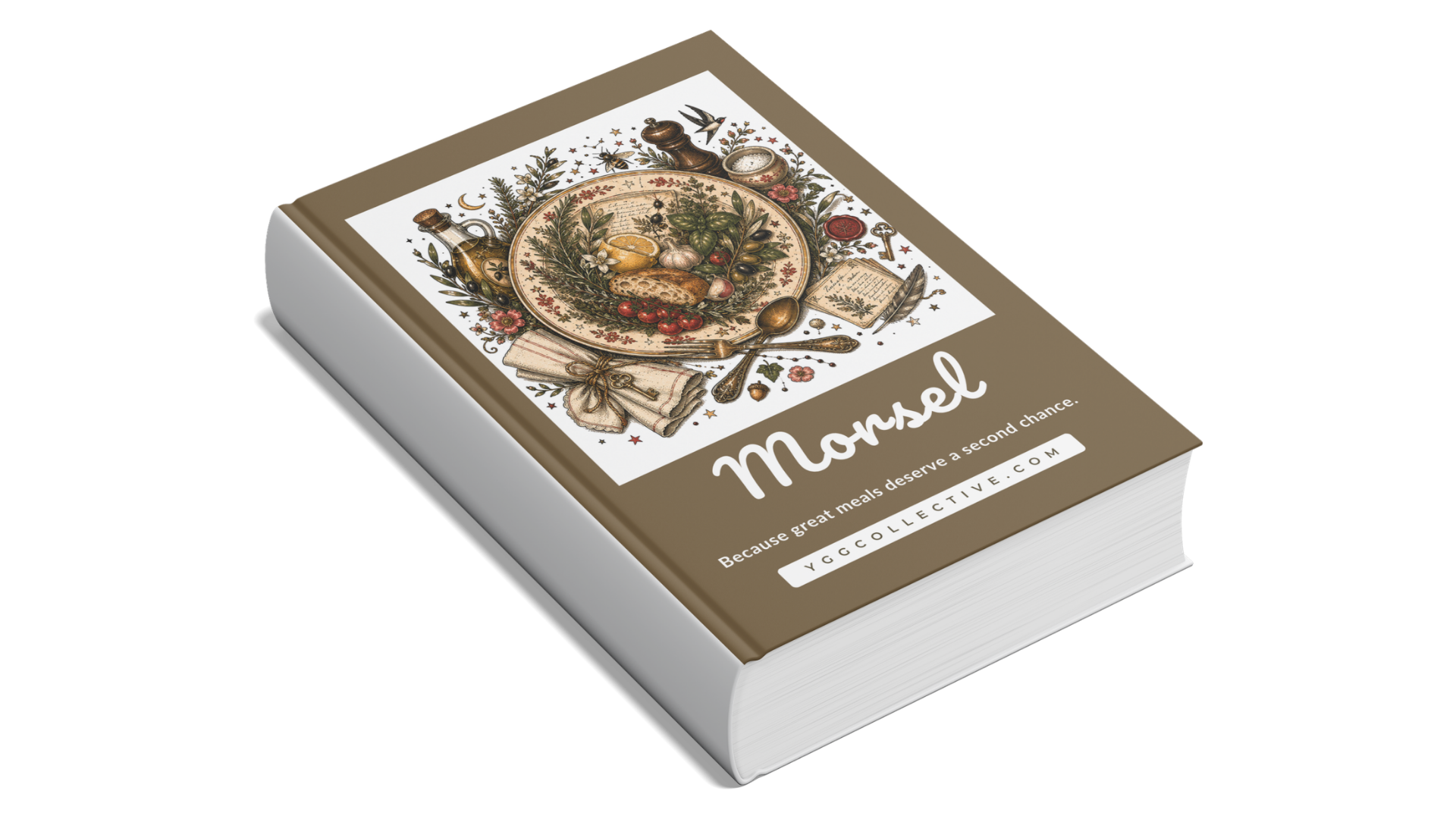
Everything you need to begin.
Your $97 CAD purchase includes:
The Morsel GPT
Your interactive AI culinary companion inside ChatGPT.
Use it to
- —Explore restaurant dishes and memorable meals.
- —Investigate ingredients, flavors, and cooking techniques.
- —Develop recipes from menus, photographs, and descriptions.
- —Reconstruct family favorites from remembered details.
- —Explore substitutions and recipe adaptations.
- —Refine recipes through further conversations.
The Morsel Companion Guide
A downloadable PDF designed to help you get started.
Including
- —Quick Start instructions
- —Conversation ideas
- —Ways to capture food memories
- —Sample recreations
- —Frequently asked questions
- —Suggestions for refining recipes over time
Immediate digital delivery
Receive access instructions and your Companion Guide after completing your purchase.
Your personal AI culinary companion.
One-time purchase. No recurring YGG membership fee.
Inside the Conversation
Understand the dish and you can take it anywhere.
Morsel treats a dish as an idea before it's a list of ingredients. Tell it what you ate and what you're wondering, and it works out why the original was memorable, then rebuilds it wherever you want to take it.
User Goal
"I had an incredible Nam Khao salad and wondered what would happen if it met Mexican flavors like chipotle & pineapple."
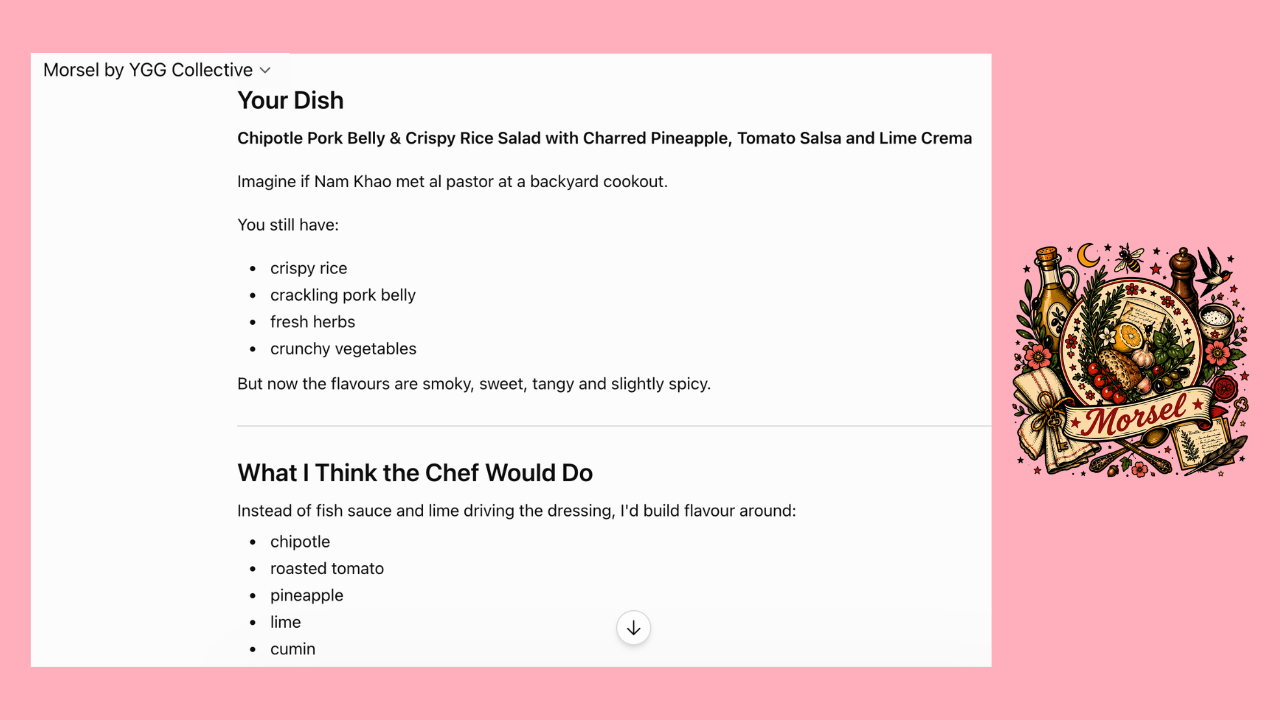
"Imagine if Nam Khao met al pastor at a backyard cookout" names the structure worth keeping: crispy rice, crackling pork belly, fresh herbs, crunch. Then it rebuilds the flavor base, with chipotle, roasted tomato, pineapple, lime and cumin where fish sauce and lime used to be.
You end up with a recipe, and with the reasoning that produced it. The reasoning is the part you keep.
A few things worth knowing.
Do I need to be an experienced cook?
Can Morsel recreate a restaurant recipe exactly?
What if I only have a photograph or a vague memory?
Can it help me adjust recipes for dietary preferences?
Will I need to buy special ingredients or equipment?
How is Morsel different from searching for recipes online?
Can I use Morsel more than once?
What do I receive after purchase?
Do I need ChatGPT Plus?
Can I get a refund?
The best meals deserve another invitation.
The little restaurant you discovered on holiday.
The family dish you’d love to bring back to the table.
The recipe you’ve been determined to master.
There’s something wonderful about taking a memorable meal and making it part of your own cooking repertoire.
Bring the menu.
Bring the photograph.
Bring whatever you remember.
Morsel will help you explore where to begin.
There's more to discover beyond the kitchen.
Meet the complete collection of guides inside The Library of Recognition.